
ATmega8 is one of the high-performance and low-cost members of the AVR high-end microcontrollers developed by ATMEL. It is widely used in household appliance manufacturers and instrumentation industries. The SL-MEGA8 development kit developed by Guangzhou Shuanglong Electronics Co., Ltd. provides hardware and software modules to help users quickly get started and design prototypes suitable for their own projects.
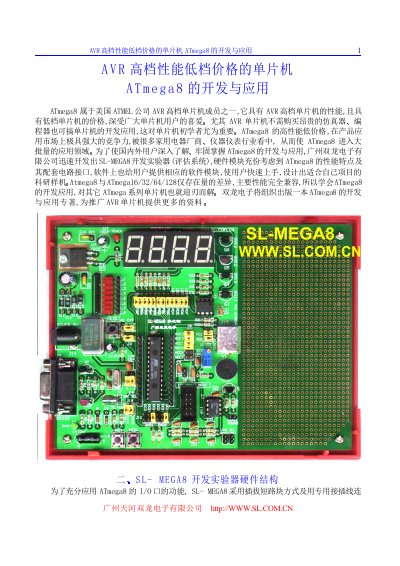
The document introduces the SL SL-MEGA8 development board designed for the high-performance, low-cost AVR microcontroller ATmega8. It details the board's hardware architecture, including various functional modules such as I/O interfaces, clock configuration, LED displays, serial communication (UART), ADC/DAC converters, I2C, PS/2 keyboard, and RTC real-time clock.
The guide provides specific instructions on configuring the board's jumpers for different modes, such as selecting external or internal oscillators and enabling boot programming. It also lists several practical experiment examples included with the software modules, covering applications like LED driving, music synthesis, ADC/DAC conversion, I2C communication, PS/2 keyboard input, and RS232 serial data transmission. This manual is written in Chinese.
The SL-MEGA8 development board is designed to help users quickly learn and develop applications using the ATmega8 microcontroller.
The board produces a +5V DC source after rectifying and filtering an input of +9V.