
VIPER06 is a switch power supply chip produced by ST company. It has 800V surge intensity, PWM control, frequency jitter, adjustable set point current limiting, soft start, fault self-restart and other features.
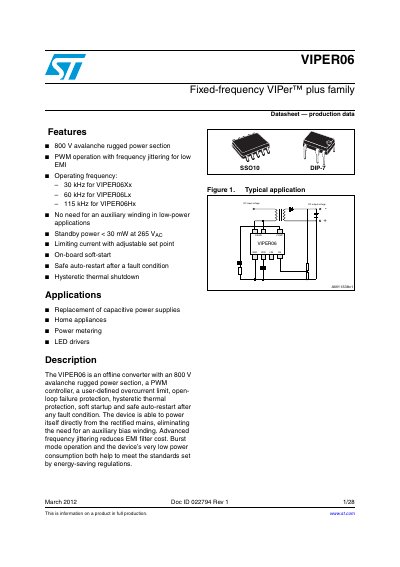
The VIPER06 is an offline converter from STMicroelectronics with an 800 V avalanche rugged power section, a PWM controller, user-defined overcurrent limit, open-loop failure protection, hysteretic thermal protection, soft startup, and safe auto-restart after a fault condition. The device can power itself directly from the rectified mains, eliminating the need for an auxiliary bias winding in low-power applications, and frequency jittering helps reduce EMI filter cost.
Operating frequency is 30 kHz for VIPER06Xx, 60 kHz for VIPER06Lx, and 115 kHz for VIPER06Hx. The datasheet gives pin settings, maximum ratings, thermal data, electrical characteristics, typical circuit information, package mechanical data for DIP-7 and SSO10, and order codes.
| Breakdown voltage | 800 V |
|---|---|
| Operating frequency (VIPER06Xx) | 30 kHz |
| Operating frequency (VIPER06Lx) | 60 kHz |
| Operating frequency (VIPER06Hx) | 115 kHz |
| Standby power | < 30 mW at 265 VAC |
| Soft-start time | 8.5 ms |
| Drain-source on-state resistance (RDS(on)) | 32 Ω at TJ = 25 °C |
The VIPER06Xx operates at 30 kHz.
No. There is no need for an auxiliary winding in low-power applications.
Standby power is less than 30 mW at 265 VAC.
The device provides safe auto-restart after a fault condition.