
The STV7622 is a data driver for Plasma Display Panels (PDP) designed in the ST’s proprietary BCD high-voltage technology. It controls up to 192 outputs via an input data bus (3, 6 or 2 × 3-bits wide) operating at up to 60MHz. This large number of outputs reduces the number of connections between the controller board and the data driver ICs. The STV7622 contains a new logic input stage that minimizes EMI resulting from the transmission of high speed TTL or LVCMOS data and clock signals. This new input stage is RSDS compliant. It enables increasing the operating frequency without compromising noise immunity. The input data bus is configured by dedicated input pins.
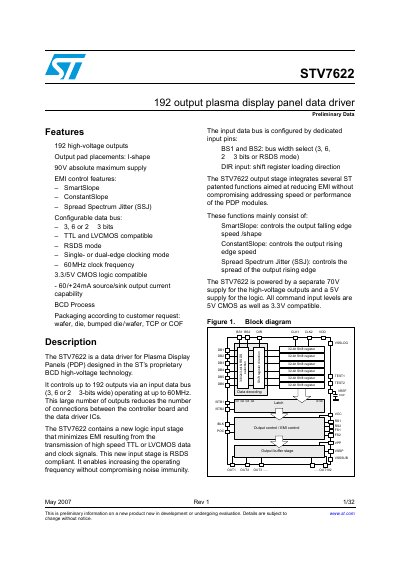
The ST STV7622 is a data driver for plasma display panels (PDP) designed in ST's proprietary BCD high-voltage technology. It controls up to 192 high-voltage outputs through a configurable 3-, 6-, or 2 x 3-bit input data bus operating at up to 60 MHz, and includes EMI control functions such as SmartSlope, ConstantSlope and Spread Spectrum Jitter.
The preliminary datasheet presents the block diagram, pin descriptions and pinout, output stage and circuit descriptions, truth tables for bus configurations, absolute maximum ratings, electrical and AC timing characteristics, pad dimensions, tested wafer disclaimer and ordering information. It also notes a separate 70 V supply for the high-voltage outputs and a 5 V logic supply.
| Number of high-voltage outputs | 192 |
|---|---|
| Absolute maximum supply | 90 V |
| Maximum clock frequency | 60 MHz |
| Data bus configurations | 3, 6 or 2 × 3 bits |
| Logic supply | 5 V |
| High-voltage output supply | 70 V |
| Output current capability | -60/+24 mA source/sink |
| RSDS termination | 100 ohm (1%) resistor |
| Packaging options | Wafer, die, bumped die/wafer, TCP or COF |
| High-voltage process | BCD |
The STV7622 is a data driver for plasma display panels (PDP) that controls up to 192 outputs through a configurable input data bus.
It supports 3-, 6-, or 2 × 3-bit data bus configurations, as well as RSDS mode.
The maximum clock frequency is 60 MHz.
In the application, TEST1 and TEST2 must be grounded at the TCP connector level.