
L293B and L293E are quad push-pull drivers capable of delivering output currents to 1A per channel
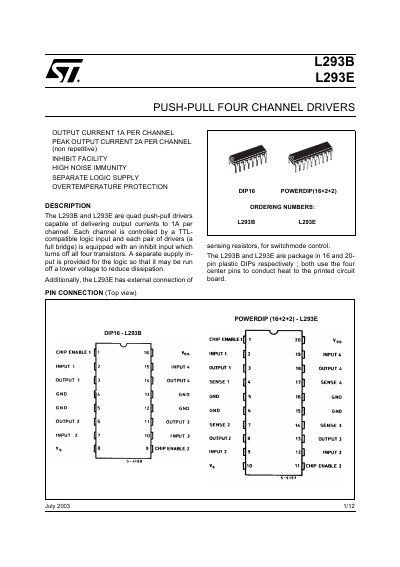
This datasheet from STMicroelectronics describes the L293B and L293E quad push-pull drivers, which deliver output currents up to 1 A per channel with a non-repetitive peak of 2 A per channel. Each channel is controlled by a TTL-compatible logic input, and each pair of drivers (a full bridge) has an inhibit input that turns off all four transistors. A separate logic supply input lets the logic run at a lower voltage to reduce dissipation. The L293E also provides external connection of sensing resistors for switchmode control.
The L293B is supplied in a 16-pin plastic DIP and the L293E in a 20-pin Powerdip, both using the four center pins to conduct heat to the printed circuit board. The document gives pin connections, block and schematic diagrams, absolute maximum ratings, thermal data, electrical characteristics and the truth table, followed by application figures for DC motor control, bidirectional DC motor control, bipolar stepping motor control and a stepping motor driver with phase current control and short circuit protection. Mounting instructions explain how to lower the junction-to-ambient thermal resistance by soldering the GND pins to a copper area or an external heatsink, and outline drawings give the package dimensions.
| Output current per channel | 1 A |
|---|---|
| Peak output current per channel (non repetitive) | 2 A |
| Supply voltage | 36 V |
| Logic supply voltage | 4.5 to 36 V |
| Input voltage | 7 V |
| Total power dissipation at Tground-pins = 80°C | 5 W |
| Storage and junction temperature | -40 to +150 °C |
| Thermal resistance junction-ambient | Max. 80 °C/W |
| Thermal resistance junction-case | Max. 14 °C/W |
| Packages | DIP16 (L293B) and Powerdip 20 (L293E) |
Each channel delivers an output current of 1 A, with a non-repetitive peak output current of 2 A per channel.
The L293B comes in a 16-pin plastic DIP and the L293E in a 20-pin Powerdip.
It can be reduced by soldering the GND pins to a suitable copper area of the printed circuit board or to an external heatsink connected to electrical ground.
The supply voltage is rated at 36 V maximum, the same limit as the logic supply voltage.