
STRH40N6 Rad-Hard P-channel 60 V, 30 A Power MOSFET Datasheet, this product has features of fast switching, 100% avalanche tested, hermetic package, 70 krad TID, SEE radiation hardened, satellite, high reliability
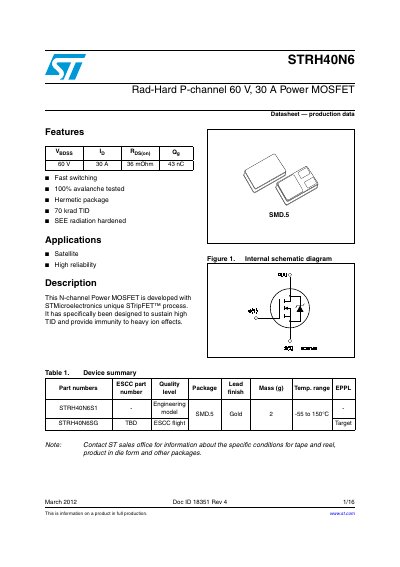
The document provides production data and specifications for the STRH40N6, a Rad-Hard P-channel 60 V, 30 A Power MOSFET. It is specifically developed using STMicroelectronics' unique STripFET™ process to sustain high Total Ionizing Dose (TID) and provide immunity to heavy ion effects.
The datasheet details absolute maximum ratings, electrical characteristics before and after irradiation, radiation characteristics including single event effects (SEE), thermal data, and package mechanical information. It covers applications in satellite systems requiring high reliability.
| Storage temperature | -55 to 150 °C |
|---|
The maximum continuous drain current at a junction temperature of 25°C is 30 A.
The storage temperature ranges from -55 to 150 °C, and the maximum operating junction temperature is 150 °C.
The total dissipation rating at a junction temperature of 25°C is 75 W.