
TS34118 Voice Switched Speakerphone Circuit
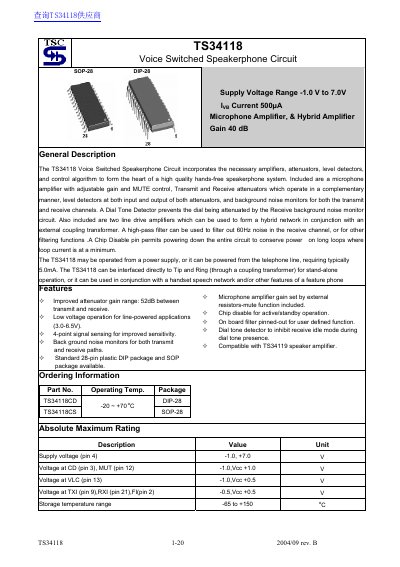
The TSC TS34118 is a Voice Switched Speakerphone Circuit designed to form the heart of a high-quality hands-free speakerphone system. It incorporates necessary amplifiers, attenuators, level detectors, and control algorithms for both transmit and receive channels. The device includes a microphone amplifier with adjustable gain and mute control, as well as transmit and receive attenuators that operate in a complementary manner.
| Supply Voltage Range | -1.0 V to 7.0V |
|---|---|
| Microphone Amplifier Gain | 40 dB |
| Operating Temperature Range | -20 ~ +70°C |
| Package Types | DIP-28, SOP-28 |
| Transmit Attenuator Gain Range | +4.0 to +8.0 dB |
| Microphone Amplifier Open Loop Gain | 70 to 80 dB |
| Hybrid Amplifier Open Loop Gain | 60 to 80 dB |
| Typical Supply Current | 5.0mA |
The operating temperature range is -20 to +70°C for the DIP-28 package.
Yes, the device can be powered from the telephone line, requiring typically 5.0mA.
A logic high (>2.0V) on the Chip Disable pin disables the IC to conserve power.
Yes, it is compatible with the TS34119 speaker amplifier.