
This document introduces the definition and characteristics of microcontrollers, as well as their role in application control functions. A microcontroller is a highly integrated device that includes most or all of the components needed to perform an application control function.
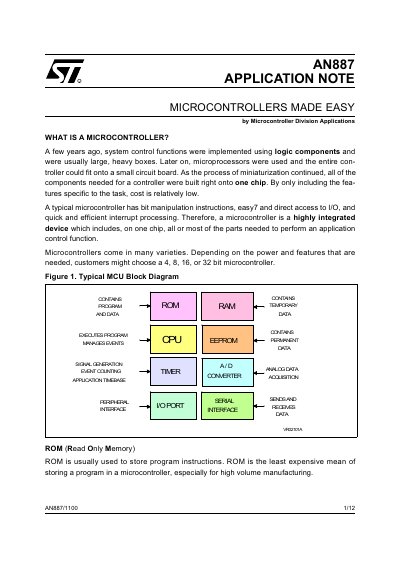
This document provides an introduction to microcontrollers (MCUs), defining them as highly integrated devices that combine processing power with memory and peripherals on a single chip. It explains how MCUs differ from standard microprocessors by focusing on cost-effective control functions for specific tasks.
The text details the internal components of a typical MCU, including ROM/Flash, RAM, EEPROM, CPU, timers, I/O ports, serial interfaces (SCI/SPI), and analog-to-digital converters. It also covers additional features such as watchdog timers, pulse width modulation, and digital signal processing capabilities.
A microcontroller is a highly integrated device which includes, on one chip, all or most of the parts needed to perform an application control function.
A watchdog timer provides a means of graceful recovery from a system problem, such as a program going into an endless loop or a hardware failure.
It is often used as a digital-to-analog conversion technique where a pulse train is generated and regulated with a low-pass filter to generate a voltage proportional to the duty cycle.