
One way to minimize the size and complexity of a battery charger is to use a linear-type charger. The linear charger drops the AC adapter voltage down to the battery voltage. The number of external components is low: linear chargers require input and output bypass capacitors, and sometimes need an external pass transistor, and resistors for setting voltage and current limits. The main pitfall of a linear charger is power dissipation. The charger simply drops the AC adapter voltage down to the battery voltage. In the case of an 800mA charger, a 5V±10% regulated AC adapter voltage, and battery voltage that varies between 4.2V and 2.5V, the power dissipation can range from 0.6W to 2.0W. This type of charger is simpler than the switch-mode type, mainly because the passive LC filter is not required. It dissipates the most power when the battery voltage is at its minimum, since the difference between the fixed input voltage and the battery voltage is greatest during this condition.
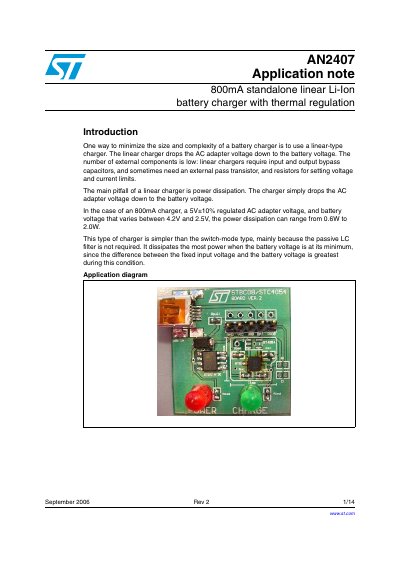
This document describes the STBC08, a constant current/constant voltage charger designed for single-cell Li-Ion batteries. It is a linear-type charger that complies with USB power specifications and features an internal block to regulate current when junction temperature increases. The device requires no external sense resistor or blocking diode and is available in a 3x3mm 6L MLP package.
| Charge Voltage | 4.2V |
|---|---|
| Maximum Charge Current | 800mA |
| Package Type | MLPD 3x3mm 6L |
| Supply Current (Shutdown Mode) | 25uA |
| Supply Current (Standby Mode) | 2uA |
| Junction Temperature Limit | 120°C |
No, the STBC08 does not require an external sense resistor or blocking diode.
The charge current limitation is programmed using a single resistor connected between the PROG and GND pins.
The charge cycle finishes when the current flowing to the battery is 1/10 of the programmed value.
If the external adaptor is removed, the STBC08 switches off and only 2uA can flow from the battery to the device.