
This paper introduces a non-isolated double output dual-buck/boost DC/DC converter topology based on the VIPerX2A family. The proposed topology is a non-isolated transformerless topology using an intermediate tap inductor and transformer. This topology operates in the 88 ~ 265 VAC wide input voltage range and can be used in low power and low cost applications.
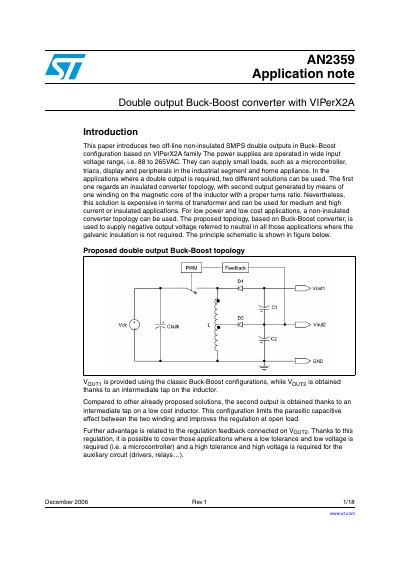
The document introduces two off-line non-insulated SMPS double outputs in Buck-Boost configuration based on the VIPerX2A family. These power supplies operate within an input voltage range of 88 to 265VAC, suitable for supplying small loads like microcontrollers and triacs in industrial segments and home appliances.
Two specific application examples are detailed: a -12V/-5V solution (3.3W) and a -24V/-5V solution (3.9W). The notes compare the topologies, highlighting that the -24V/-5V configuration offers better efficiency due to lower parasitic capacitance effects between windings compared to the -12V/-5V option.
The -12V/150mA and -5V/300mA solution provides 3.3W, while the -24V/100mA and -5V/300mA solution provides 3.9W.
The converters are operated in a wide input voltage range from 88 to 265VAC.