
This article discusses the effect of long-term drift (LTD) on voltage references. LTD is a parameter that can be confusing and misleading, and it can cause significant accuracy limitations in a system. The article explains the significance of LTD and provides a typical LTD curve example.
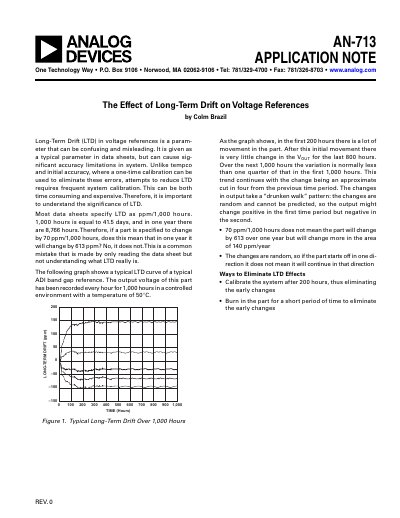
This document discusses Long-Term Drift (LTD) in voltage references, noting that it is often misunderstood as a linear parameter. Unlike temperature coefficient or initial accuracy, LTD cannot be fully eliminated by a one-time calibration and requires frequent system recalibration, which can be time-consuming and expensive. The text clarifies that data sheet specifications of ppm/1,000 hours do not imply a linear change over a year; for example, a specification of 70 ppm/1,000 hours does not result in a 613 ppm change over 8,766 hours. Instead, the drift typically stabilizes after an initial period of significant movement, often resulting in a total annual change closer to 140 ppm for parts specified at 70 ppm/1,000 hours. The output voltage changes follow a random, unpredictable pattern often described as a "drunken walk."
The document provides practical methods to eliminate the effects of LTD. It suggests calibrating the system after the first 200 hours to account for the initial significant movement in the part's output. Additionally, it recommends burning in the part for a short period of time to eliminate these early changes before the system is deployed, ensuring more stable long-term performance.
No, this is a common mistake. The part will change more in the area of 140 ppm/year.
You can calibrate the system after 200 hours or burn in the part for a short period of time.
No, the changes are random and cannot be predicted, following a "drunken walk" pattern.