
MC145026 Supplier Query
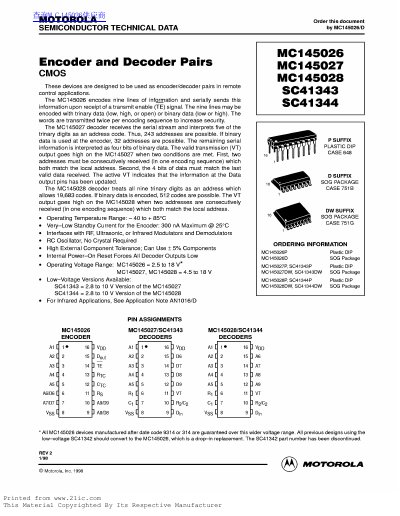
This document provides technical data for the MC145026 encoder and MC145027/MC145028 decoders, which are designed for use as encoder/decoder pairs in remote control applications. The MC145026 encodes nine lines of information (trinary or binary) and transmits them serially upon receipt of a transmit enable signal. The decoders interpret the serial stream to verify addresses and data, outputting a valid transmission signal when conditions are met.
| Operating Temperature Range | -40 to +85°C |
|---|---|
| Very-Low Standby Current (Encoder) | 300 nA Maximum @ 25°C |
| Operating Voltage (MC145026) | 2.5 to 18 V |
| Operating Voltage (MC145027/MC145028) | 4.5 to 18 V |
| Low-Voltage Version Voltage (SC41343/SC41344) | 2.8 to 10 V |
| Power Dissipation | 500 mW |
| Storage Temperature | -65 to +150 °C |
| Encoder Clock Frequency (5.0V) | 0.001 to 2.0 MHz |
The nine lines may be encoded with trinary data (low, high, or open) or binary data (low or high).
If trinary data is used, 243 addresses are possible; if binary data is used, 32 addresses are possible.
No, the device features an RC oscillator that does not require a crystal.