
MOTOROLA MC145026, MC145027, MC145028, SC41343, SC41344 are designed to be used as encoder/decoder pairs in remote control applications.
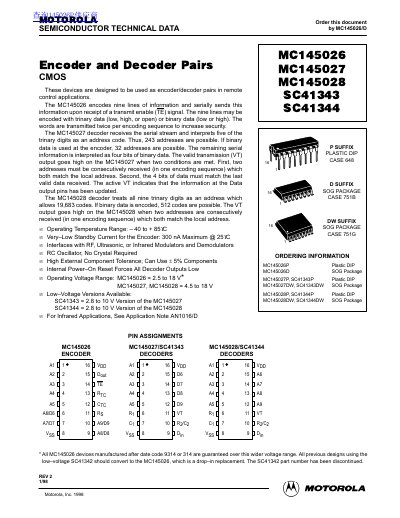
This document provides technical data for the MC145026, MC145027, MC145028, SC41343, and SC41344 CMOS devices. These components are designed to function as encoder/decoder pairs in remote control applications. The MC145026 encoder serially sends nine lines of information, which can be encoded as trinary (low, high, or open) or binary data. The decoder pairs, MC145027 and MC145028, interpret this serial stream to verify addresses and data, outputting a valid transmission (VT) signal when conditions are met.
The datasheet details the pin assignments, block diagrams, maximum ratings, and electrical characteristics for all listed models, including low-voltage versions. It specifies operating voltage ranges from 2.5V to 18V for the MC145026 and 4.5V to 18V for the decoders, with specific limits for the SC41343 and SC41344 variants. Switching characteristics and test circuit diagrams are also provided to assist in circuit design and verification.
| Operating Temperature Range | -40 to +85°C |
|---|---|
| Very-Low Standby Current (Encoder) | 300 nA Maximum @ 25°C |
| Operating Voltage (MC145026) | 2.5 to 18 V |
| Operating Voltage (MC145027/MC145028) | 4.5 to 18 V |
| Operating Voltage (SC41343/SC41344) | 2.8 to 10 V |
| Power Dissipation | 500 mW |
| Storage Temperature | -65 to +150 °C |
The nine lines may be encoded with trinary data (low, high, or open) or binary data (low or high).
If trinary data is used, 243 addresses are possible; if binary data is used, 32 addresses are possible.
No, the device features an RC oscillator that does not require a crystal.