
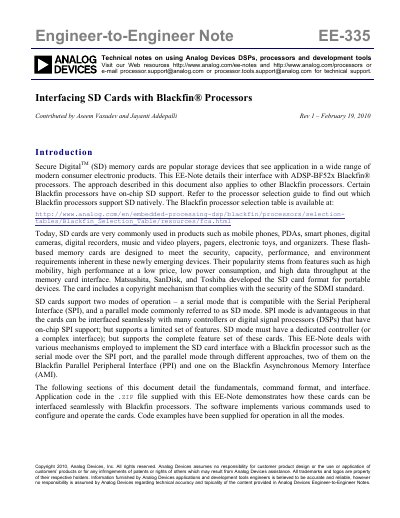
Analog Devices EE-335 Interfacing SD Cards with Blackfin Processors Application Note


Analog Devices EE-335 Interfacing SD Cards with Blackfin Processors Application Note - cover page
Brand
Analog Devices
Category
Other Electronics
Document type
Application Note
Language
English
Pages
28
File format
PDF
File size
2.6 MB
Published
03 August, 2012
Updated
29 September, 2023
MD5 checksum
F68DCDE0B632F0FAB985239D60837E32

About this manual

Secure Digital (SD) memory cards are popular storage devices used in consumer electronics. This document explains the fundamentals of SD cards, including their serial and random access capabilities, form factors, and communication protocols.

The guide specifically covers interfacing these cards with Analog Devices Blackfin processors. It details two primary methods: using the Serial Peripheral Interface (SPI) port for a simpler setup or utilizing the Parallel Peripheral Interface (PPI) and Asynchronous Memory Interface (AMI) for full feature support.

What's inside

  • SD Memory Card Fundamentals
  • Interface Signals
  • Registers
  • Interface with Blackfin Processors: SPI Mode
  • SPI Implementation Details
  • Protocol, Commands, and Responses

Frequently asked questions

Which Blackfin processors have native SD support?

Certain Blackfin processors have on-chip SD support; refer to the processor selection guide for specific details.

What are the two operation modes for SD cards?

SD cards support a serial mode compatible with SPI and a parallel mode commonly referred to as SD mode.

What is the maximum operating clock frequency for SD cards?

The maximum operating clock frequency can go up to 25 MHz in default mode or up to 50 MHz in high-speed mode.

Download PDF (2.6 MB)

More Analog Devices Manuals


View all Analog Devices manuals →