
This document is a reference design manual published by Analog Devices about ADAU1761, ADAV801/ADAV803
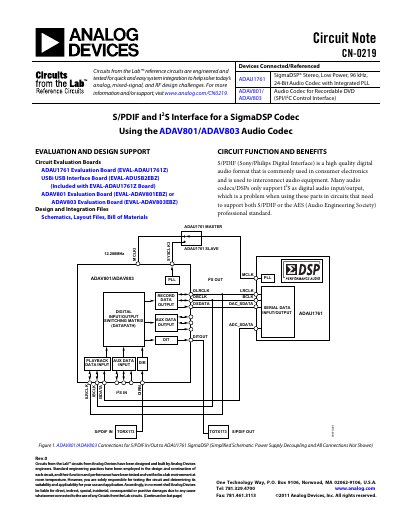
The document presents a reference circuit (CN-0219) that connects an ADAU1761 SigmaDSP processor with either the ADAV801 or ADAV803 audio codec. This configuration allows for high-quality digital audio conversion between I²S and S/PDIF formats, addressing integration challenges where codecs only support one format natively.
The circuit utilizes fiber optic transmitters (TOTX173) and receivers (TORX173) to handle the S/PDIF input and output. It details the connection of clock lines (LRCLK, BCLK) and data lines between the devices in both master and slave configurations. The text also provides information on required evaluation boards, software tools like SigmaStudio, and test procedures using an Audio Precision analyzer.
The software requires a PC with at least 128 MB of RAM, though 256 MB is recommended.
With a full-scale 1 kHz input tone, the THD + N should be approximately 130 dB.
Eight single pin jumper cables are required to make the necessary connections.