
The AD573 is a 10-bit successive approximation analog-to-digital converter that includes a DAC, voltage reference, clock, comparator, successive approximation register (SAR) and three-state output buffers, all fabricated on a single chip. No external components are required to perform a full accuracy 10-bit conversion in 20 µs. The AD573 incorporates advanced integrated circuit design and processing technologies. The successive approximation technique is used to implement the conversion, which is a digital conversion technique in which the input signal is compared with the reference voltage at each conversion. The result of the comparison is the most significant bit that is discarded, and the other bits are used to calculate the next reference voltage.
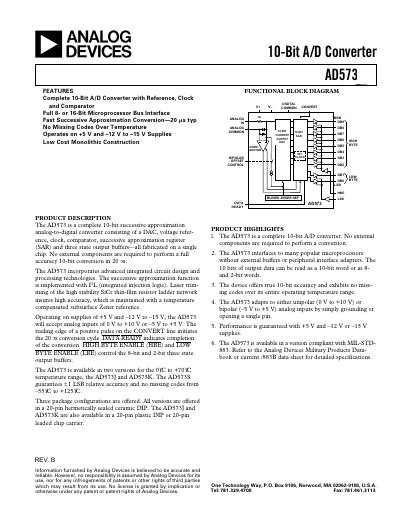
The AD573 is a complete 10-bit successive approximation analog-to-digital converter consisting of a DAC, voltage reference, clock, comparator, successive approximation register (SAR), and three-state output buffers, all fabricated on a single chip. It is designed for use with +5 V and –12 V to –15 V supplies and accepts analog inputs of 0 V to +10 V or –5 V to +5 V. The device offers true 10-bit accuracy with no missing codes over its entire operating temperature range and requires no external components to perform a full accuracy conversion in 20 µs.
| Resolution | 10 Bits |
|---|---|
| Conversion Time | 20 µs typ |
| Operating Temperature Range | 0 °C to +70 °C |
| Analog Input Range (Unipolar) | 0 V to +10 V |
| Analog Input Range (Bipolar) | -5 V to +5 V |
| Power Supply Voltage (V+) | +5 V |
No external components are required to perform a full accuracy 10-bit conversion in 20 µs.
The conversion time is typically 20 µs.