
This user guide describes the AD9284 evaluation board, which provides all of the support circuitry required to evaluate the high performance and low power characteristics of the AD9284. The evaluation board also provides the necessary features for measuring the performance of the AD9284, such as an SPI interface, clock source, analog signal source, anti-aliasing filter and data acquisition tool.
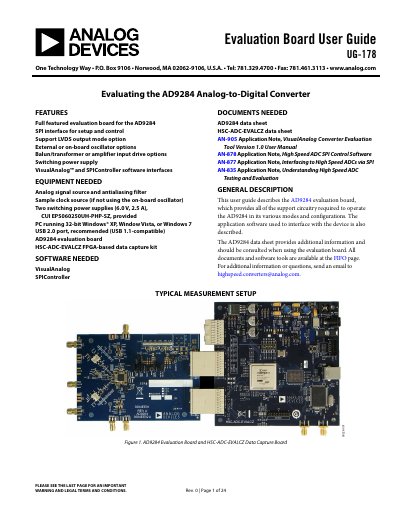
This document is the user guide for the AD9284 evaluation board, which provides all necessary support circuitry to operate the AD9284 analog-to-digital converter in various modes. It details the equipment and software needed, including VisualAnalog and SPIController interfaces.
| Power Supply Output | 6 V, 2 A maximum |
|---|---|
| Input Frequency Range | up to ~200 MHz |
| Reference Voltage | 1.0 V |
| RBIAS Default Setting | 10 kΩ |
The required software includes VisualAnalog and SPIController.
Add a shorting jumper across J202 at Pin 2 and Pin 3 to connect the SDIO/PDWN pin to DRVDD.
The nominal input drive level is 10.5 dBm to achieve 1.5 V p-p full scale into 50 Ω.