
Multiparameter parameter patient monitoring devices must leverage ever-improving technology to meet demands for improvements in accuracy, functionality, and size, as well provide advances in data capture, transmission, storage, and compatibility—ultimately empowering improved healthcare and enhanced patient outcomes.
This document is a technical article by Bill Crone, a Healthcare Systems Engineer at Analog Devices, Inc. It addresses the technological challenges and requirements for developing multiphysiological parameter medical devices used in various clinical environments.
The text details the need for these devices to monitor multiple vital signs simultaneously, such as 12-lead ECG, oxygen saturation (SpO2), carbon monoxide (CO), hemoglobin, temperature, blood pressure, respiration, and pacemaker activity. It highlights the importance of accuracy, functionality, size reduction, data transmission, storage, and compatibility with medical records to improve patient outcomes.
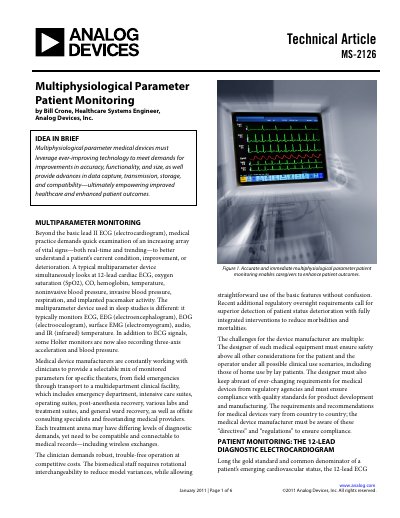
A typical multiparameter device simultaneously monitors 12-lead cardiac ECG, oxygen saturation (SpO2), CO, hemoglobin, temperature, noninvasive blood pressure, invasive blood pressure, respiration, and implanted pacemaker activity.
Diagnostic quality requires a frequency response of 0.05 Hz to 150 Hz.