
The BT100 Battery Capacity Tester is designed for measuring the internal resistance and output voltage of batteries including lead storage cell, nickel-cadmium battery, lithium-ion battery and nickel-metal hydride battery. It adopts AC four-terminal method to eliminate lead resistances and contact resistances, yielding the most accurate results. It has a 1kHz test current with up to 10µΩ resistance resolution and dual display to simultaneously indicate the internal resistance and voltage of the battery. The tester also features a comparator function with storage of up to 99 sets of resistance and voltage values for battery deterioration characterization. It comes with pin type and alligator type 4-terminal Kelvin leads for quick and accurate resistance measurements. The memory capacity can store up to 999 manually stored data points or up to 9600 points stored using interval datalogging. It is equipped with an RS232 PC port and Windows compatible software.
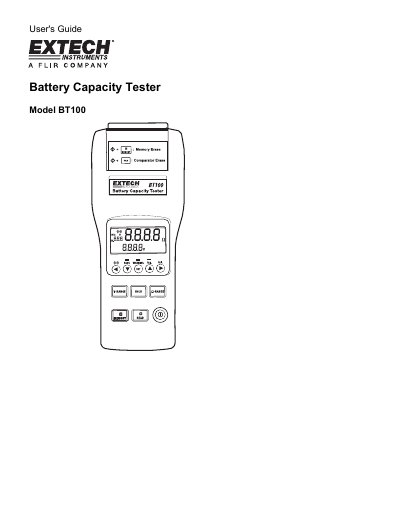
The Extech BT100 is a battery capacity tester designed to measure the internal resistance and output voltage of lead storage cell, nickel-cadmium, lithium-ion, and nickel-metal hydride batteries. It utilizes an AC four-terminal method with a 1kHz test current to eliminate lead resistances and contact resistances for accurate results.
The device features a dual display that simultaneously indicates internal resistance and voltage, along with a comparator function capable of storing up to 99 sets of values. Users can perform manual data logging for up to 999 sets or continuous interval datalogging for up to 9600 points. The unit includes an RS232 PC port compatible with Windows software for data analysis.
| Measuring method | AC four-terminal method |
|---|---|
| Test current frequency | 1kHz + 10% |
| Sampling rate | 1 set/second |
| Operating environment temperature | 32 to 104°F (0° to 40°C) |
| Power source | Six AA size 1.5V batteries |
The tester is designed for measuring lead storage cell, nickel-cadmium battery, lithium-ion battery and nickel-metal hydride battery.
The device allows for 99 sets of resistance and voltage values to be stored for battery deterioration characterization.
The maximum permissible input voltage to the measurement terminal is 50VDC.