
H11AA1M, H11AA2M, H11AA3M, H11AA4M are AC input/phototransistor optocouplers with bipolar emitter input and built-in reverse polarity input protection. They are suitable for applications such as AC line monitoring, unknown polarity DC sensors, and telephone line interfaces.
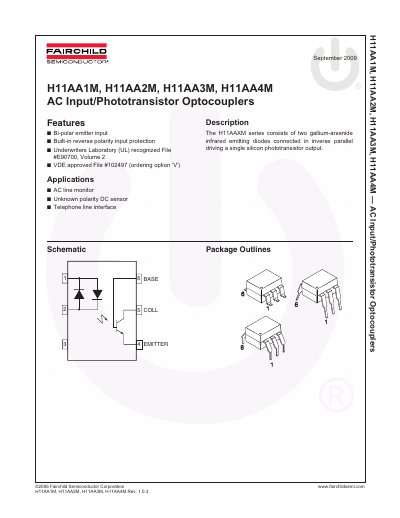
The document describes the H11AAXM series of AC Input/Phototransistor Optocouplers manufactured by Fairchild Semiconductor. These devices consist of two gallium-arsenide infrared emitting diodes connected in inverse parallel, driving a single silicon phototransistor output. Key features include bi-polar emitter input and built-in reverse polarity input protection.
| Operating Temperature Range | -40 to +100 °C |
|---|---|
| Continuous Forward Current (Emitter) | 60 mA |
| Continuous Collector Current | 50 mA |
| Isolation Voltage | 7500 Vac(pk) |
They are suitable for AC line monitoring, unknown polarity DC sensing, and telephone line interfaces.
The maximum operating temperature is 100 °C.
The maximum continuous forward current is 60 mA.
The maximum working insulation voltage is 850 V peak.