
The UCC3917 family is a positive floating hot swap manager that provides complete power management, hot swap, and fault handling capability. It features precision fault threshold, programmable average power limiting, programmable linear current control, programmable overcurrent limit, etc.
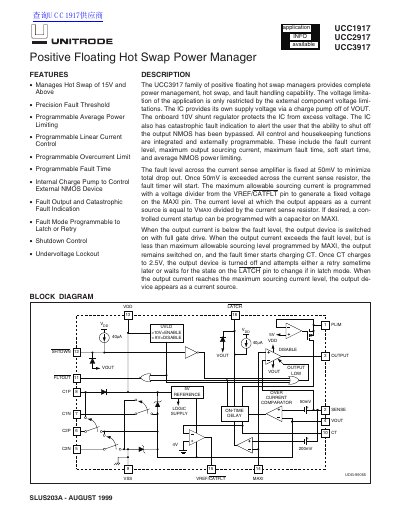
The document details the Unitrode UCC1917 family of positive floating hot swap managers. These integrated circuits provide complete power management, hot swap, and fault handling capabilities for applications restricted only by external component voltage limitations. The ICs generate their own supply voltage via an internal charge pump off of VOUT and include a 10V shunt regulator to protect against excess voltage.
| Supply Current (Ibb) | 3.0 to 11 mA |
|---|---|
| UVLO Turn On Threshold | 7.9V to 9.7V |
| Overcurrent Threshold (Ta = 25°C) | 47.5mV to 53mV |
| Output High Voltage (Iout = 0) | 6V to 10V |
| Shutdown Threshold | 2.0V to 2.8V |
The overcurrent threshold is typically 50mV, with a range of 47.5mV to 53mV.
The IC provides its own supply voltage via a charge pump off of VOUT.
Pulling this pin low causes a fault to latch until the pin is brought high or a power on reset is attempted.