
UCC15701/2 UCC25701/2 UCC35701/2 Advanced Voltage Mode Pulse Width Modulator
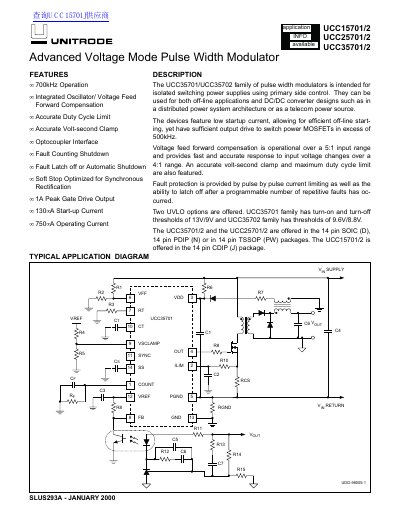
The Unitrode UCC15701/2, UCC25701/2, and UCC35701/2 family of devices are advanced voltage mode pulse width modulators intended for isolated switching power supplies using primary side control. They support both off-line applications and DC/DC converter designs, featuring a 700kHz operation frequency and integrated oscillator with voltage feedforward compensation. The devices offer accurate duty cycle limits, volt-second clamps, and optocoupler interfaces for fault protection.
| Operation Frequency | 700kHz |
|---|---|
| Supply Current (Active) | 750uA |
| Peak Gate Drive Output | 1A |
| Start-up Current | 130A |
| Package Types | 14 pin SOIC, PDIP, TSSOP, CDIP |
| UVLO Turn-on Threshold (UCCX5702) | 9.6V |
| UVLO Turn-off Threshold (UCCX5702) | 8.8V |
They are intended for isolated switching power supplies using primary side control, suitable for off-line applications and DC/DC converter designs.
The UCC35701 family has turn-on and turn-off thresholds of 13V and 9V respectively.
The UCC35702 family has turn-on and turn-off thresholds of 9.6V and 8.8V respectively.
The devices support a 700kHz operation frequency.