
The TPS2042 and TPS2052 dual power distribution switches are intended for applications where heavy capacitive loads and short circuits are likely to be encountered. They are dual high-side power switches that incorporate two 135-mΩ N-channel MOSFETs in a single package. Each switch is controlled by a logic enable that is compatible with 5-V logic and 3-V logic. Gate drive is provided by an internal charge pump that is designed to control the power-switch rise times and fall times to minimize current surges during switching. The charge pump requires no external components and allows operation from supplies as low as 2.7 V. When the output load exceeds the current-limit threshold or a short is present, the TPS2042 and TPS2052 limit the output current to 500 mA.
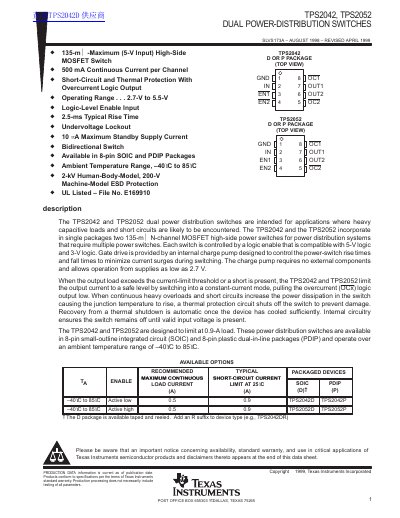
The TPS2042 and TPS2052 are dual power-distribution switches designed for applications involving heavy capacitive loads and short circuits. Each device incorporates two 135-mΩ N-channel MOSFET high-side power switches controlled by logic enable inputs compatible with 5-V and 3-V logic. An internal charge pump drives the gate voltage to minimize current surges during switching, requiring no external components and allowing operation from supplies as low as 2.7 V.
These switches feature robust protection mechanisms, including constant-current limiting and thermal shutdown to prevent damage from overloads or short circuits. The TPS2042 uses an active-low enable input, while the TPS2052 uses an active-high enable input. Both devices are available in 8-pin SOIC and PDIP packages and operate over an ambient temperature range of -40°C to 85°C.
| Continuous current per channel | 500 mA |
|---|---|
| Short-circuit current limit (TPS2042) | 0.9 A |
| Short-circuit current limit (TPS2052) | 1 A |
| Operating temperature range | -40°C to 85°C |
| ESD protection (Human Body Model) | 2 kV |
| Minimum operating voltage | 2.7 V |
The TPS2042 uses an active-low enable input, whereas the TPS2052 uses an active-high enable input.
No, the internal charge pump requires no external components and allows operation from supplies as low as 2.7 V.
The device limits the output current to a safe level by switching into a constant-current mode and pulls the overcurrent logic output low.