
Agilent 6100 series quadrupole CZE-MS systems offer exceptional performance, robustness, and ease of use. The systems are the culmination of many generations of development in quadrupole CZE-MS and combine unmatched performance, robustness, and ease of use in a compact footprint that is half the size of the previous generation. The Agilent 6100 series offers you a choice of four models: the economical entry-level 6110, the 6120 with polarity switching, and the high-performance and flexible 6130 and 6140. The 6110 and 6120 are ideal for a wide range of applications and their affordable price brings the power of mass spectrometry to many more laboratories than ever before. The 6130 offers an extended mass range, unmatched sensitivity, and the ability to acquire multiple-mode data in a single analysis by switching modes on each scan. The 6140's fast scanning makes CZE-MS research easier. It is ideal for high-resolution fast and ultrafast CZE as well as high-throughput injection applications. The four models in the Agilent 6100 series integrate seamlessly with Agilent's other LC and MS systems, providing you with a complete solution for sophisticated analyses without the hassle.
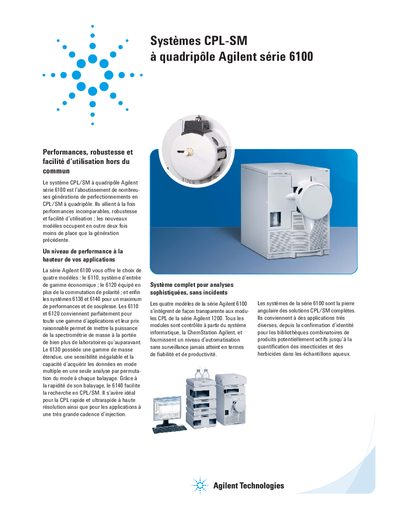
The Agilent 6100 Series LC/MS Quadrupole Systems represent the culmination of generations of improvements, combining incomparable performance, robustness, and ease of use. The series offers four models: the 6110 for economical entry-level applications, the 6120 with polarity switching, and the high-performance 6130 and 6140 systems. These systems occupy half the space of the previous generation while providing a level of performance suitable for diverse applications, from combinatorial library confirmation to pesticide quantification. This manual is written in French.
| Sensitivity | picogramme |
|---|---|
| Space efficiency | two times less |
It is designed for sophisticated analyses ranging from confirming identities in combinatorial libraries to quantifying insecticides and herbicides in aqueous samples.
The system has a sensitivity on the order of picograms for both electrospray ionization and atmospheric pressure chemical ionization.
Up to four different sets of acquisition conditions can be utilized for every single analysis.