
The document introduces how to optimize the Agilent 1100 Series system for high throughput, including using fast gradients, short columns and high flow rates
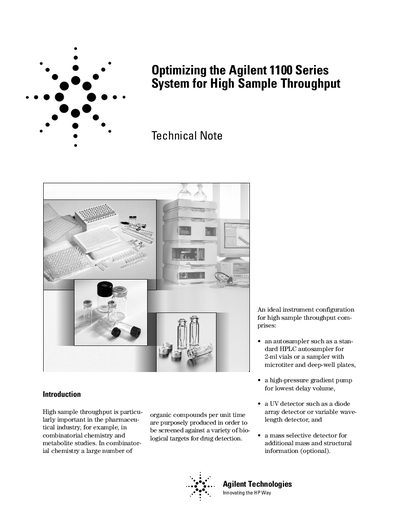
This document is a technical note aimed at the pharmaceutical industry, specifically addressing combinatorial chemistry and metabolite studies. It outlines an ideal instrument configuration for high-throughput applications, including specific components of the Agilent 1100 Series such as the high-pressure gradient pump, vacuum degasser, autosampler, and detectors.
The text details a methodology to significantly reduce standard HPLC cycle times (typically 15-20 minutes) to less than two minutes. This optimization is achieved by adjusting chromatographic parameters including column length, gradient steepness, flow rate, delay volume, data acquisition rate, and column temperature. The document provides experimental results demonstrating baseline separation of various compounds within these shortened timeframes.
| Standard HPLC cycle times (gradient analysis) | 15 and 20 min |
|---|---|
| Target optimized cycle time | less than two minutes |
| Flow rate range tested | 1 ml/min to 4 ml/min |
| Minimum detectable concentration (UV) | 0.1 ppm range |
| Maximum flow rate for MSD detector | about 1 to 1.5 ml/min |
Cycle times must be shortened by using fast gradients with short columns and high flow rates.
Switching the autosampler into bypass mode saves another 300 pl of delay volume, reducing run time.