
Optimizing the Agilent high-throughput analysis system for high performance and precision
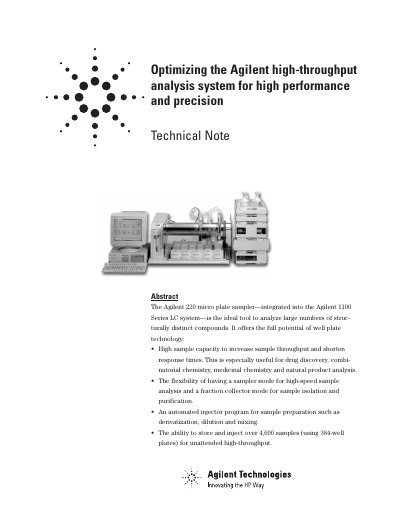
This document is a technical note describing how to optimize the hardware and software setup of the Agilent 220 micro plate sampler (MPS) when integrated into the Agilent 1100 Series HPLC system. The goal is to achieve higher performance and precision for combinatorial chemistry and high-throughput screening applications.
The text details specific parameters influencing sampler performance, including drawn sample volume, draw speed, air gap size, and dilutor syringe size. It provides recommendations for settings such as overfilling the sample loop, selecting appropriate draw speeds to balance precision and throughput, and using specific commands like 'Create Air Gap' to prevent sample mixing. The document also covers techniques for injecting volumes smaller than the loop size (Centered Loop Fill, Partial Loop Fill) and strategies to minimize carry over.
| Maximum sample storage capacity | 4,600 samples (using 384-well plates) |
|---|---|
| Control software version | Agilent ChemStation version A.07.01 |
| Sampler software version | version A.03.01 |
| Recommended air gap size | 2-3 pl |
The best precision is achieved with the lowest draw speed of 0.5 ml/min, though higher speeds reduce analysis time.
It prevents mixing of the sample with the solvent in the tube connected to the dilutor syringe.