
This document introduces the detection characteristics of Agilent Model 255 NCD and FID, and their combined use methods.
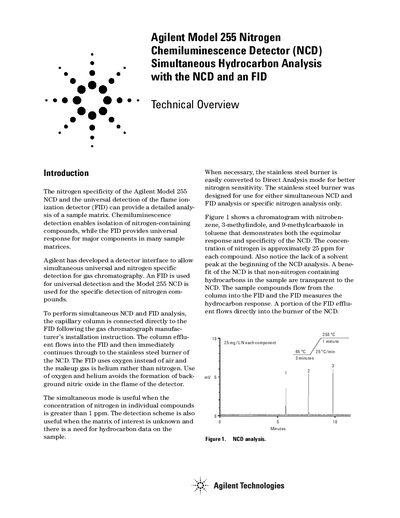
The Agilent Model 255 Nitrogen Chemiluminescence Detector (NCD) is designed to provide detailed sample matrix analysis by combining nitrogen specificity with universal detection. It works in tandem with a flame ionization detector (FID), where the capillary column effluent flows into the FID and then immediately continues through to the NCD's stainless steel burner.
This simultaneous mode allows for the isolation of nitrogen-containing compounds while providing a universal response for major components, such as hydrocarbons. The system is particularly useful when the concentration of nitrogen in individual compounds exceeds 1 ppm or when the sample matrix is unknown and requires hydrocarbon data.
It is used for the specific detection of nitrogen compounds in gas chromatography.
This mode is useful when the concentration of nitrogen in individual compounds is greater than 1 ppm.