
The copper strip corrosion test is commonly used as a product specification for liquid petroleum gases (LPGs). The test is designed to detect the presence of components that may be corrosive to copper and copper-alloy fittings that come into contact with the product. While the test is very simple to perform, its interpretation can be subjective. Furthermore, the test can produce erroneous results and it does not indicate the actual cause of corrosion, although it is generally assumed to be due to sulfur compounds. Some situations where copper strip corrosion does not perform satisfactorily are as follows. While the presence of carbonyl sulfide does not cause corrosion in LPG systems, corrosive hydrogen sulfide is formed upon hydrolysis of carbonyl sulfide. Thus, an LPG could pass the copper strip corrosion test at its point of production and yet fail at its point of delivery or simply upon storage for a few days. Different LPGs may each pass the copper strip corrosion test, but when commingled could fail. This occurs because of hydrolysis as described or because one could contain a low level of hydrogen sulfide and the other could contain a low level of elemental sulfur. Hydrogen sulfide and elemental sulfur are known to have a synergistic effect on corrosivity. An LPG product could contain corrosive amounts of hydrogen sulfide and yet pass the Agilent Model 355 Sulfur Chemiluminescence Detector (SCD) test.
The copper strip corrosion test (ASTM D1838) is a common specification for liquid petroleum gases (LPGs) but can produce subjective or erroneous results. It does not indicate the actual cause of corrosion, which is often assumed to be sulfur compounds. Situations where the test fails to perform satisfactorily include the presence of carbonyl sulfide, which hydrolyzes into corrosive hydrogen sulfide during storage or transport, and the synergistic effect of hydrogen sulfide and elemental sulfur in commingled LPGs. Additionally, masking agents like amines, glycol amines, and sulfolane can inhibit copper tarnish, causing an LPG to pass the test despite containing corrosive levels of hydrogen sulfide.
It provides a rapid means to identify and quantify various sulfur compounds present in LPGs.
The information it generates explains why a particular product passes or fails the copper strip corrosion test.
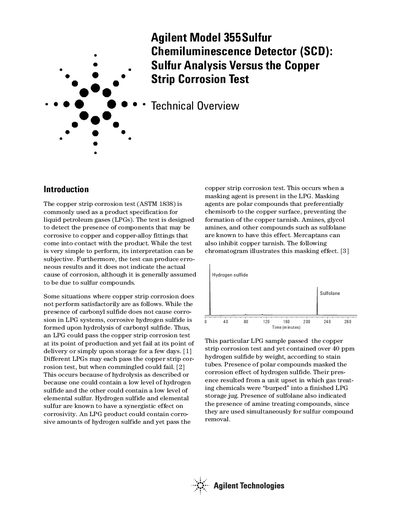
The LPG sample contained over 40 ppm hydrogen sulfide by weight.