
This document introduces the combination of Agilent 1200 Series Diode Array Detector (DAD), Agilent 6140 Single Quadrupole LC/MS system and Agilent 1200 Series Evaporative Light Scattering Detector (ELSD) which can detect non-UV absorbing compounds.
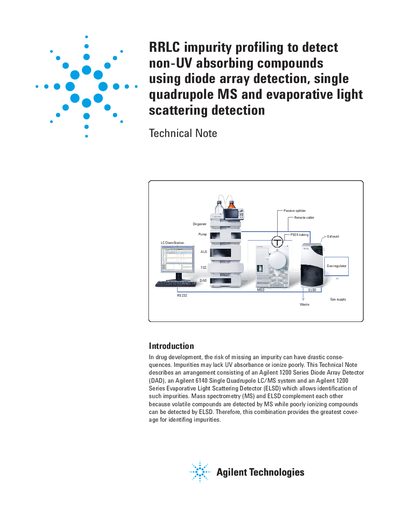
In drug development, missing impurities can have drastic consequences. This document details an analytical setup combining an Agilent 1200 Series Diode Array Detector (DAD), an Agilent 6140 Single Quadrupole LC/MS system, and an Agilent 1200 Series Evaporative Light Scattering Detector (ELSD). This combination allows for the identification of impurities that lack UV absorbance or ionize poorly by utilizing MS and ELSD in parallel with DAD in series.
The note provides step-by-step instructions on setting up the system using a passive flow splitter to maintain additional UV/DAD detection while running ELSD and MSD. It includes experimental parameters, analysis of specific compounds like glutamine and topiramate, and guidelines for obtaining appropriate flow split ratios using various PEEK tubing lengths and IDs to ensure operation within nebulizer specifications.
| Column dimensions | 50x3.0 mm, 1.8 pm ZORBAX Eclipse XDB C18 |
|---|---|
| Mobile phase A composition | 0.1% formic acid in Milli Q water |
| Mobile phase B composition | 0.1% formic acid in acetonitrile |
| Flow rate | 1 mL/min |
| Injection volume | 5 uL |
| MSD ESI Drying gas flow | 13 L/min |
Mass spectrometry (MS) and Evaporative Light Scattering Detection (ELSD) complement each other because volatile compounds are detected by MS while poorly ionizing compounds can be detected by ELSD.
The specified operating flow rate for an ELSD Standard nebulizer is between 0.2 and 2.5 mL/min.
It is best to use smaller ID red (0.13 mm) or yellow (0.18 mm) tubings to connect the two detectors due to dilution effects seen with larger ID tubing.