
This product is a Huawei MateBook X Pro notebook, equipped with Intel's 10th generation Core i5-1035G1 processor, 16GB of RAM and 512GB of SSD, supports fingerprint recognition and face recognition, uses a 2.5K resolution IPS screen, the screen bezel is very narrow, and the overall appearance is very beautiful.
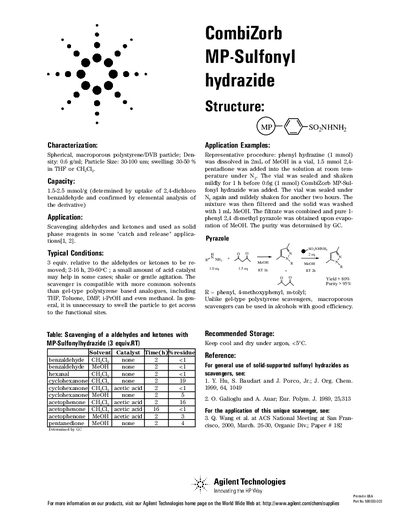
This document is a technical datasheet for the Agilent CombiZorb MP-Sulfonyl hydrazide product. It describes the physical characteristics of the material, which consists of spherical, macroporous polystyrene/DVB particles with a density of 0.6 g/ml and a particle size range of 30-100 um.
The primary application for this scavenger is removing aldehydes and ketones in organic synthesis, particularly in 'catch and release' applications. The document provides typical reaction conditions, including solvent compatibility (such as THF, Toluene, DMF, i-PrOH, and methanol), catalyst usage, and timeframes. It also includes a table of scavenging results for various aldehydes and ketones under different conditions.
| Particle Type | Spherical, macroporous polystyrene/DVB particle |
|---|---|
| Density | 0.6 g/ml |
| Particle Size | 30-100 um |
| Swelling in THF or CH2Cl2 | 30-50 % |
| Capacity | 1.5-2.5 mmol/g |
It is used for scavenging aldehydes and ketones and as a solid phase reagent in 'catch and release' applications.
No, unlike gel-type polystyrene based analogues, it is generally unnecessary to swell the particle to get access to the functional sites.
The product should be kept cool and dry under argon at a temperature below 5°C.