
This document introduces a method for quality control of recombinant peptide and protein drugs by capillary HPLC. The method uses an Agilent 1100 series binary pump, vacuum degasser, autosampler, diode array detector and a 10-mm path length, 500-nL flow cell.
This document discusses the increasing importance of recombinant peptide and protein drugs in the pharmaceutical industry and the necessity of testing every batch for purity. It highlights that while 1D gels and conventional HPLC are used, capillary HPLC offers superior resolution and lower sample consumption, making it ideal for expensive materials and compatibility with mass spectrometers.
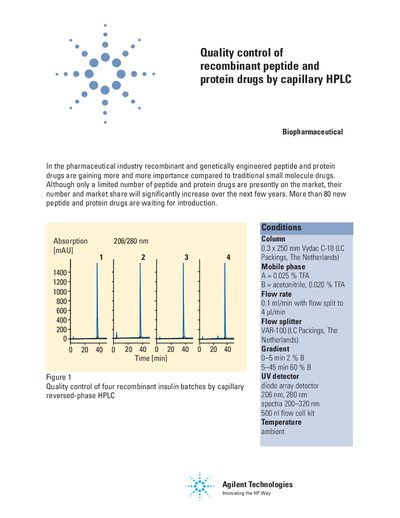
The text details a specific application using the Agilent 1100 Series system to analyze four batches of recombinant insulin. The equipment listed includes a binary pump, autosampler, diode array detector with a capillary flow cell, and Agilent ChemStation software. The analysis utilized a Vydac C-18 column with a specific gradient of acetonitrile and TFA.
| Absorption | 206/280 nm |
|---|---|
| Flow cell volume | 500 nl |
| Flow cell path length | 10-mm |
| Software | Agilent ChemStation + 3D software |
Capillary HPLC combines great resolution capability with UV detection, allows for little sample consumption, and can be easily connected to a mass spectrometer.
The quantitative analysis showed impurities of 0.3% in samples 1 and 2, 1.9% in sample 3, and 4.0% in sample 4.