
This document introduces a new frequency modulator for reducing EMI. It can generate a low EMI clock from crystal, ceramic resonator or system clock, which can reduce the EMI of downstream clock and data dependent signals in the system.
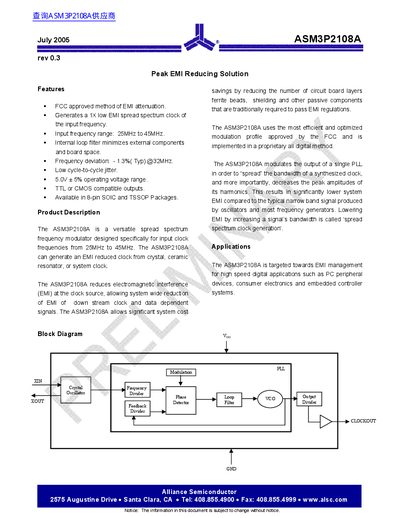
The ASM3P2108A is a versatile spread spectrum frequency modulator designed specifically for input clock frequencies ranging from 25MHz to 45MHz. It generates an EMI-reduced clock from crystal, ceramic resonator, or system clock sources. The device uses a proprietary all-digital method to modulate the output of a single PLL, effectively decreasing the peak amplitudes of harmonics and lowering system-wide electromagnetic interference (EMI).
| Input frequency range | 25MHz to 45MHz |
|---|---|
| Operating voltage | 5.0V +/- 5% |
| Frequency deviation | - 1.3% (Typ) @32MHz |
| Output rise time | 440 ps (Typ) |
| Output fall time | 300 ps (Typ) |
| Cycle-to-cycle jitter | 360 ps (Max) |
| Output duty cycle | 45% to 55% |
The device supports input frequencies from 25MHz to 45MHz.
The device operates with a 5.0V supply voltage with a tolerance of +/- 5%.
The component is available in 8-pin SOIC and TSSOP packages.