
This article describes the method of analyzing dissolved gases in transformer oil using gas chromatography. By using a gas chromatograph with a stripper column, the identification and quantification of fault gases in electrical insulating oils can be performed, allowing for early detection of equipment issues.
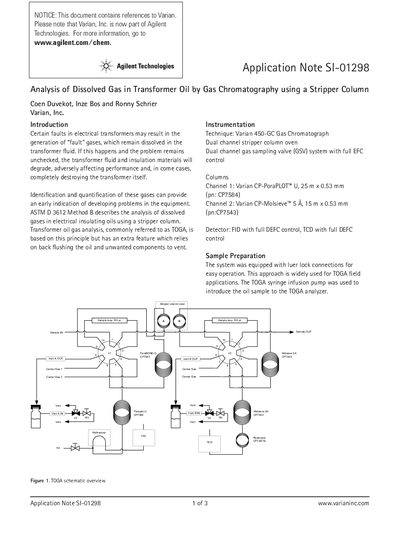
This document details an application for analyzing dissolved gases in electrical insulating oils (TOGA) to detect faults in transformers. The method utilizes ASTM D 3612 Method B principles, employing back flushing of oil and unwanted components.
The procedure uses a Varian 450-GC Gas Chromatograph equipped with a dual channel stripper column oven and a dual channel gas sampling valve (GSV) system. Two separate channels analyze the extracted gases: one using Argon carrier gas to detect lighter gases like hydrogen, oxygen, and nitrogen via TCD; the other using Helium carrier gas to detect carbon gases (CO, CO2, hydrocarbons) via FID with a methanizer.
The instrument is used to analyze dissolved gases in transformer oil to identify faults that could degrade the fluid and insulation materials.
The system requires Helium at 35.5 psi and Argon at 10.4 psi as carrier gases.
The methanizer oven must be set to 400 °C.