
The AD5200 and AD5201 are programmable resistor devices that can be digitally controlled through a 3-wire SPI serial interface. These devices perform the same electronic adjustment function as mechanical potentiometers.
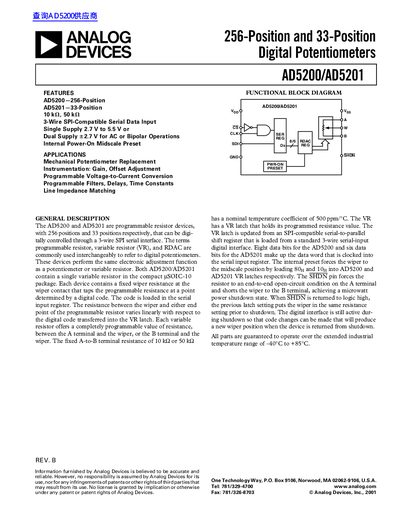
The Analog Devices AD5200 and AD5201 are programmable resistor devices that function as variable resistors or RDACs. The AD5200 offers 256 positions, while the AD5201 provides 33 positions. Both devices feature a single variable resistor in a compact uSOIC-10 package and can be digitally controlled through a 3-wire SPI-compatible serial interface.
These components are designed for applications such as mechanical potentiometer replacement, instrumentation gain and offset adjustment, programmable voltage-to-current conversion, and line impedance matching. They operate with a single supply of 2.7 V to 5.5 V or dual supplies for AC/bipolar operations.
| Resistance (AD5201) | 50 kΩ |
|---|---|
| Supply Voltage Range | 2.7 V to 5.5 V (Single) |
| Resolution (AD5200) | 8 Bits |
| Resolution (AD5201) | 6 Bits |
| Temperature Range | -40°C to +85°C |
The fixed A-to-B terminal resistance is available in 10 kΩ or 50 kΩ options.
They are controlled through a 3-wire SPI-compatible serial data input.