
The AD5570 is a 16-bit, ±12V/±15V, serial input, voltage output DAC from Analog Devices. It features 1LSB max INL and DNL, an output voltage range up to ±14V, and on-board reference buffers, eliminating the need for a negative reference.
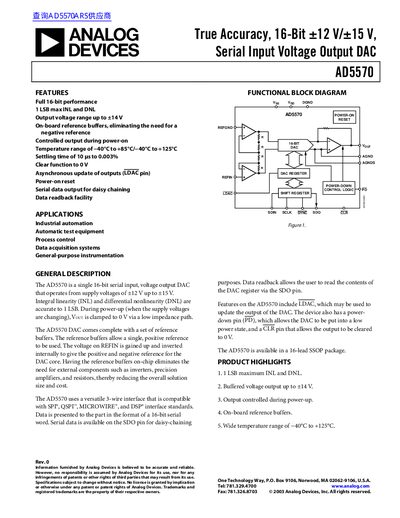
The AD5570 is a single 16-bit serial input, voltage output Digital-to-Analog Converter (DAC) designed for industrial automation, automatic test equipment, process control, and data acquisition systems. It operates from supply voltages of ±12 V up to ±15 V and features full 16-bit performance with integral linearity (INL) and differential nonlinearity (DNL) accurate to 1 LSB.
| Resolution | 16 Bits |
|---|---|
| Differential Nonlinearity (DNL) | −1 to +1 LSB |
| Output Voltage Range | ±14 V |
| Supply Voltage Range | ±12 V to ±15 V |
| Operating Temperature Range (W, Y Grades) | -40°C to +125°C |
The device features an output voltage range up to ±14 V.
Yes, it uses a versatile 3-wire interface compatible with SPI®, QSPI™, MICROWIRE™, and DSP® standards.
No, it includes on-board reference buffers that eliminate the need for external components like inverters or precision amplifiers.