
This document introduces the LTC3619 and LTC3619B, two synchronous buck regulators with precise input current limits. These regulators can maximize input power usage while ensuring the stability of the input power supply.
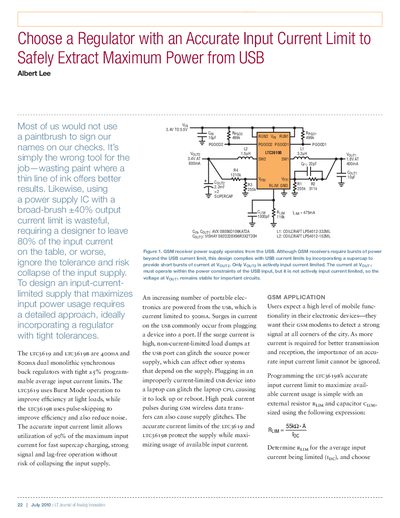
The document discusses the design of a power supply that maximizes input power usage while adhering to strict USB current limits. It highlights the benefits of using regulators like the LTC3619, which feature tight tolerances for programmable average input current limits, preventing supply collapse during high-current bursts.
Specific applications covered include powering GSM modems and driving LED lights from a 5V USB source. The text provides circuit examples showing how to configure the regulator with external resistors and capacitors to set specific current limits (e.g., 400mA) and utilize features like Burst Mode or pulse-skipping for efficiency.
The LTC3619 has a tight +5% programmable average input current limit.
The LTC3619 uses Burst Mode operation to improve efficiency when operating under light load conditions.
In the provided GSM application example, the regulator converts a 5V USB input.