
The CPM2C Micro PLC is suitable as a controller for simple stand-alone machines, as well as a simple networked controller. One innovation is the new synchronisation instruction, which makes it possible to generate output pulse trains as a function of an input pulse frequency, e.g. to emulate the synchronisation of 2 axes through a variable gear ratio. Furthermore, PID control and pulse width modulation can also be realised easily by preconfigured instructions. PLC programs from the CPM1/CPM1A and the CPM2A can be used with the CPM2C. Programming is carried out using the CX-Programming software.
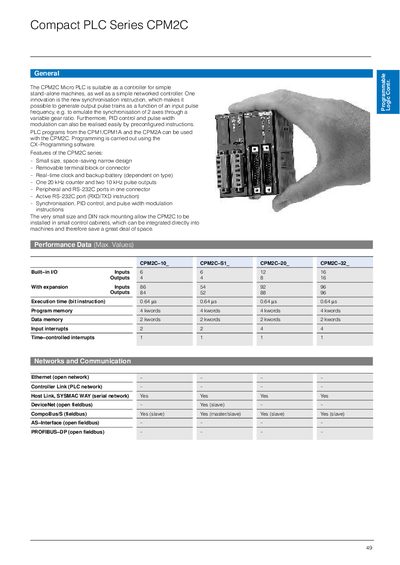
The document provides a comprehensive guide for the Omron CPM2C Micro PLC, which is designed as a controller for simple stand-alone machines and basic networked applications. Key innovations highlighted include synchronization instructions for generating output pulse trains based on input frequencies, PID control capabilities, and pulse width modulation via preconfigured instructions.
The manual details various CPU unit models within the series, including those with relay or transistor outputs (PNP/NPN), different I/O counts (6 to 16 inputs/outputs), and options for data backup using capacitors or batteries. It also covers system configuration on DIN rails, expansion capabilities up to five units, and communication interfaces such as RS-232C, Host Link, SYSMAC WAY, DeviceNet, and CompoBus/S.
| Execution time (bit instruction) | 0.64 us |
|---|---|
| Program memory | 4 kwords |
| Data memory | 2 kwords |
| Voltage supply | 24 VDC |
| High-speed counter max frequency | 20 kHz |
Yes, PLC programs from the CPM1/CPM1A and the CPM2A can be used with the CPM2C.
Up to five Expansion Units can be connected to CPM2C CPU Units.
No, the performance data table indicates that Ethernet (open network) is not supported for this series.