
This design note presents a simple, compact, and high efficiency LED flashlamp circuit suitable for use in cellular telephones and cameras. The circuit uses the LT ®3468-1 as the main controller.
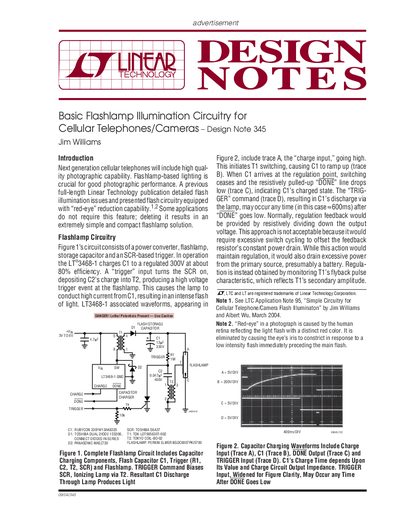
The document presents a design solution for high-quality photographic capability in next-generation cellular telephones. The proposed circuit utilizes an SCR-based trigger to discharge a storage capacitor through a flashlamp, achieving efficient illumination without the complexity of red-eye reduction features.
Key components identified include the LT3468-1 power converter, a Toshiba S6A37 SCR, and specific transformers and capacitors. The design achieves regulated 300V charging with approximately 80% efficiency and produces a flash event lasting about 200 microseconds.
| Charging Voltage | 300V |
|---|---|
| Charging Efficiency | 80% |
| SCR Model | TOSHIBA S6A37 |
| Transformer T1 Model | TDK LDT585630T-002 |
| Transformer T2 Model | TOKYO COIL-BO-02 |
| Flashlamp Model | PERKIN ELMER BGDCOO07PKIS700 |
| Total Event Duration | 200us |
The circuit consists of a power converter (LT3468-1), a storage capacitor, an SCR-based trigger, and a flashlamp.
Regulation is obtained by monitoring T1's flyback pulse characteristic rather than using resistive feedback.
The total event duration is approximately 200 microseconds.