
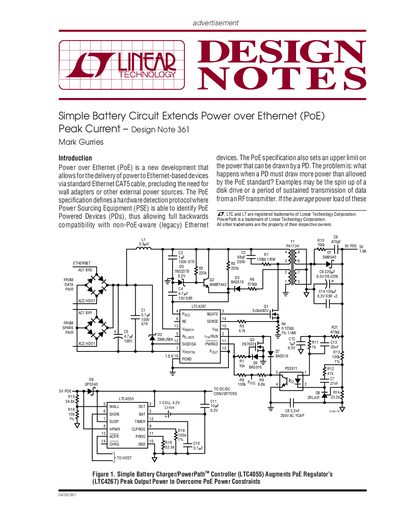
This design note describes a simple battery charger/PowerPath™ controller (LTC4055) that augments the peak output power of a PoE regulator (LTC4267) to overcome PoE power constraints.
Power over Ethernet (PoE) allows delivery of power via standard CAT5 cable, but standards limit the maximum draw. This document addresses scenarios where a Powered Device (PD) requires more power than PoE provides, such as during disk drive spin-up or RF transmission bursts.
The proposed solution utilizes a rechargeable battery to store energy when consumption is low and release it during high-demand periods. The circuit employs the LTC4267 for PoE detection and regulation, and the LTC4055 for PowerPath control and Li-ion charging. This combination enables seamless switching between PoE power, battery power, or a parallel configuration to augment peak load current without delay.
The standard calls for the Power Sourcing Equipment to break the circuit if the PoE current exceeds 400mA.
The LTC4267 circuit supplies 5V at 1.8A.
In the provided circuit, the charge current is limited to 900mA.