
This document introduces the op amp selection guide for optimum noise performance by Linear Technology, including noise characteristics, thermal noise of resistors, and quantifying resistor noise.
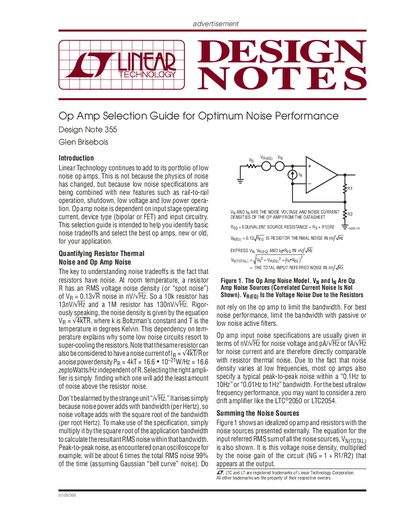
This document serves as a selection guide for choosing the best operational amplifiers (op amps) from Linear Technology's portfolio. It explains how to quantify resistor thermal noise versus op amp noise, detailing the impact of input stage operating current and device type on overall performance.
The text provides methods for summing noise sources in a circuit and includes graphical plots to help designers identify candidate op amps that offer optimal noise performance for specific source resistance values.
For best noise performance, you should limit the bandwidth with passive or low noise active filters.
Peak-to-peak noise will be about 6 times the total RMS noise 99% of the time.
Most op amps specify a typical peak-to-peak noise within a "0.1Hz to 10Hz" or "0.01Hzto 1Hz" bandwidth.