
The document introduces a new type of isolated converter with simplicity and performance design, which can achieve high efficiency, low cost, and minimum part count similar to buck converters.
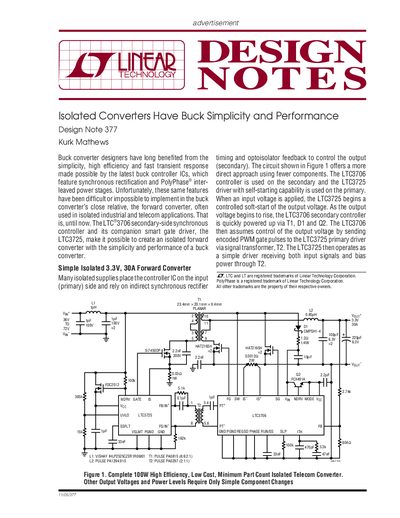
This document details a design approach for creating an isolated forward converter that offers the simplicity, efficiency, and fast transient response typically associated with buck converters. It utilizes the LTC3706 secondary-side synchronous controller paired with the LTC3725 smart gate driver on the primary side to eliminate complex optoisolator feedback loops.
The note explains how this combination allows for direct control of the output voltage from the secondary side, simplifying the design process and reducing component count. It also covers PolyPhase current sharing capabilities for higher power applications and provides a complete circuit example for a 100W telecom converter.
They allow designers to create an isolated forward converter with the simplicity, high efficiency, and fast transient response of a buck converter.
The LTC3725 acts as a primary-side smart gate driver that receives encoded PWM gate pulses from the secondary controller via a signal transformer.