
This document introduces an efficient and low-cost alternative to LEDs for backlighting handheld computer displays. The document analyzes the advantages and disadvantages of the two primary competing backlight solutions (white LEDs and Cold Cathode Floresent Lamps), and proposes a compact CCFL circuit design.
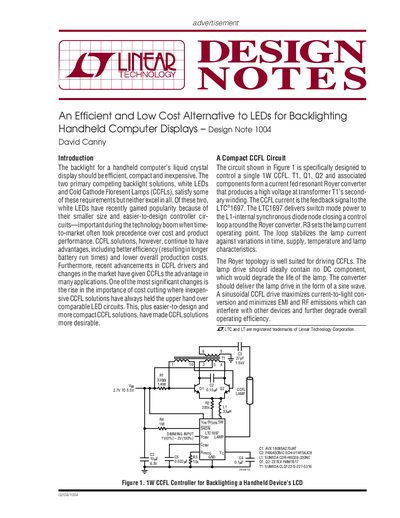
This document presents an efficient and low-cost alternative to LEDs for backlighting handheld computer displays using Cold Cathode Fluorescent Lamps (CCFLs). It highlights the advantages of CCFL solutions, such as better efficiency and lower production costs, while addressing design challenges with a specific circuit topology.
| Input Voltage Range | 2.7V to 5.5V |
|---|---|
| Internal Switches | two internal 1A MOSFET switches |
| Oscillator Frequency | 300kHz |
| Reference Voltage | 0.8V |
| Lamp Current Limiting | R3 sets the lamp current operating point |
CCFL solutions offer better efficiency resulting in longer battery run times and lower overall production costs.
Yes, an on-chip PWM dimming circuit allows intensity control from zero to full brightness based on voltage at the Vdim pin.