
This data sheet introduces the features of PIC16F627 and PIC16F628, including CPU, peripherals, memory, etc.
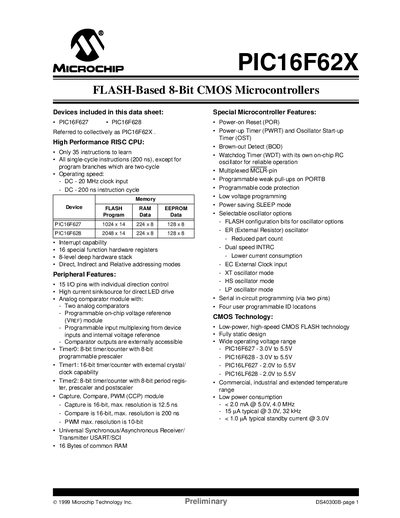
The PIC16F62X family comprises low‑cost, high‑performance 8‑bit CMOS microcontrollers with FLASH program memory, RAM, EEPROM, and a rich set of peripherals. They support a 35‑instruction RISC core, an eight‑level hardware stack, and multiple interrupt sources.
Key features include up to 20 MHz operation, 3.0‑5.5 V (2.0‑5.5 V for LF variants) supply range, 15 configurable I/O pins, three timer modules (Timer0, Timer1, Timer2), comparator modules, a USART, and on‑chip voltage reference. The devices are offered in 18‑pin DIP, SOIC, and SSOP packages and support in‑circuit serial programming.
| Maximum Clock Frequency | 20 MHz |
|---|---|
| Instruction Cycle Time | 200 ns |
| Flash Program Memory (words) | 1024 (PIC16F627) / 2048 (PIC16F628) |
| RAM Data Memory (bytes) | 224 |
| EEPROM Data Memory (bytes) | 128 |
| I/O Pins | 15 |
| Voltage Supply Range | 3.0 V – 5.5 V (2.0 V – 5.5 V for LF devices) |
The PIC16F627 operates from 3.0 V to 5.5 V.
The family provides 15 I/O pins with individual direction control.
Each instruction executes in a single 200 ns cycle, except branches which take two cycles.
The devices support up to a 20 MHz clock input.