
This product is a circular connector that complies with IEC 60130-9 standard, IP68 protection class, with threaded joint and solder terminals, 360 ° shielded.
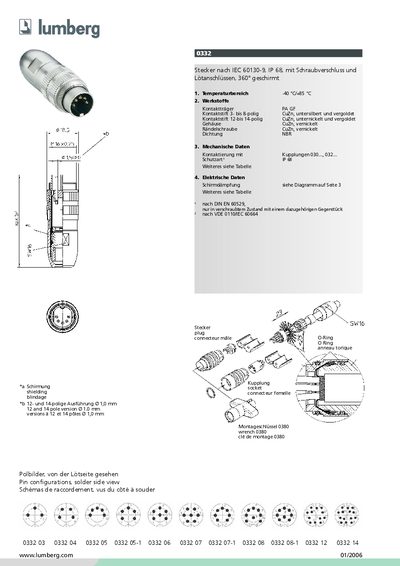
The 0332 series from Lumberg consists of circular connectors with a threaded joint, available in 3‑8 pole and 12‑14 pole versions. They comply with IEC 60130‑9, have an IP68 protection class and operate from –40 °C to +85 °C.
The document lists mechanical data (housing material PA GF, NBR gasket, knurled copper screws), electrical data (contact materials, attenuation curves) and packaging details. Tables show the different part numbers and their corresponding dimensions and ratings. This manual is written in German.
| Operating temperature range | -40 °C to +85 °C |
|---|---|
| Contact pins (3‑8 pole version) | Copper, pre‑silvered and gilded |
| Contact pins (12‑14 pole version) | Copper, pre‑nickel and gilded |
| Housing material | PA GF (glass‑filled polyamide) |
| Gasket material | NBR |
| Mating socket series | 030, 032 |
| Packaging | Individual parts in a plastic bag |
They can be used from –40 °C up to +85 °C.
The 3‑8 pole contacts are copper, pre‑silvered and gilded; the 12‑14 pole contacts are copper, pre‑nickel and gilded.
They are supplied as a set of individual parts in a plastic bag inside a cardboard box.