
The AD8230 is a low drift, differential sampling, precision instrumentation amplifier. Auto-zeroing reduces offset voltage drift to less than 50nV/°C. The AD8230 is well-suited for thermocouple and bridge transducer applications. The AD8230's high CMR (110 dB) rejects line noise in measurements
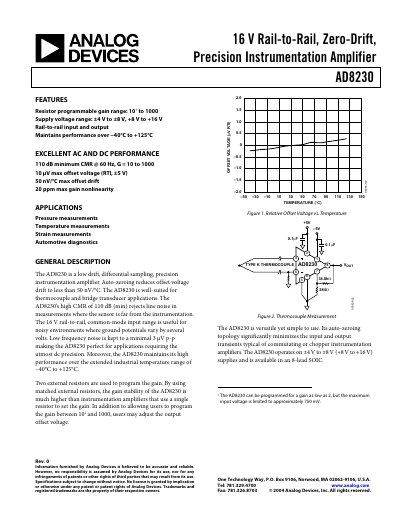
The AD8230 instrumentation amplifier offers low offset voltage (≤10 µV) and ultra‑low drift (≤50 nV/°C) thanks to its auto‑zeroing architecture. It operates from ±4 V to ±8 V dual supplies or +8 V to +16 V single supply and maintains performance over –40 °C to +125 °C.
The device provides a programmable gain range of 101–1000, high common‑mode rejection (≥110 dB at 60 Hz), and low noise (≈3 µV p‑p from 0.1 Hz to 10 Hz). It is supplied in an 8‑lead SOIC package and includes ESD protection and recommended layout guidelines for optimal operation.
| Supply Voltage Range | ±4 V to ±8 V (dual) or +8 V to +16 V (single) |
|---|---|
| Gain Range | 101 to 1000 (V/V) |
| Offset Drift | ≤50 nV/°C |
| Common‑Mode Rejection (CMR) | ≥110 dB at 60 Hz |
| Input Differential Voltage | 750 mV |
| Quiescent Current (typical) | 2.7 mA (–40 °C) to 3.5 mA (125 °C) |
| Output Swing | –VS +0.1 V to +VS –0.2 V |
The AD8230 can be programmed for a gain from 101 to 1000 V/V.
The offset drift is limited to 50 nV per degree Celsius.
It operates from ±4 V to ±8 V dual supplies or from +8 V to +16 V single supply.
The device provides at least 110 dB CMR at 60 Hz.