
The MAX1562/MAX1562H/MAX1563 single current-limited switches provide up to 4A to power up to eight USB ports. They operate from a 4V to 5.5V input supply and consume only 40µA of quiescent current when operating and only 3µA in shutdown. The MAX1562/MAX1562H/MAX1563s’ autoreset feature latches the switch off if the output is shorted, thereby saving system power. When the short is removed, the switch is reactivated. A fault-blanking feature enables the circuit to ignore momentary faults, such as those caused when hot swapping a capacitive load, preventing false alarms to the host system. Fault blanking also prevents fault signals from being issued when the device powers up the load. The MAX1562/MAX1562H/MAX1563 provide several safety features to protect the USB port. Built-in thermal-overload protection turns off the switch when the die temperature exceeds +160°C. Accurate internal cur- rent-limiting circuitry protects the input supply against both overload and short-circuit conditions. An open- drain fault signal (FAULT) notifies the microprocessor when a thermal-overload, current-limit, undervoltage lockout (UVLO), or short-circuit fault occurs. The MAX1562 has an active-low ON, and the MAX1562H has an active-high ON enable input. The MAX1563 has a selectable active-high or active-low logic-controlled enable. The current limit is pro- grammed from 1A to 4A using a resistor. The MAX1562/MAX1562H are available in 8-pin SO packages and are pin-compatible u
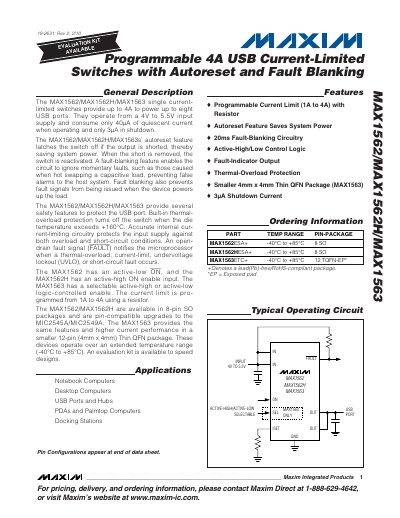
The MAX1562/MAX1562H/MAX1563 family provides programmable current‑limited switching for USB ports, supporting up to 4 A (MAX1563) or 3 A (MAX1562/1562H). The devices operate from a 4 V‑5.5 V supply, consume only a few µA in standby, and include features such as autoreset, fault‑blanking, UVLO, and thermal‑overload protection.
Typical applications include notebook and desktop computers, USB hubs, PDAs, docking stations, and other devices that require protected USB power. The current limit is set with a single resistor, and an open‑drain FAULT output signals overload, short‑circuit, UVLO, or thermal‑shutdown events.
| Supply Voltage Range | 4.0 V – 5.5 V |
|---|---|
| Switch On‑Resistance (typical) | 50 mΩ |
| Standby Supply Current (switch disabled) | 10 µA |
| Quiescent Supply Current (switch enabled, IOUT=0 A) | 80 µA |
| Maximum Continuous Switch Current | 5 A |
| Thermal‑Shutdown Temperature | +160 °C |
| Undervoltage‑Lockout (UVLO) Threshold | 2.9 V – 3.8 V |
| Fault Output Low‑Voltage Level | 0.4 V |
The device can continuously switch up to 5 A, with a peak short‑circuit current of up to 5 A as well.
The current limit is programmed by connecting a resistor between the ISET pin and ground; the limit follows the equation I LIM = 17120 / R ISET.
The switch enters short‑circuit current‑limit mode, pulses the output at about 30 % above the programmed limit, and asserts the FAULT output after the fault‑blanking period.
A built‑in thermal‑overload circuit shuts the switch off when the junction temperature exceeds +160 °C, and the device will restart after the temperature drops by about 15 °C.