
The MAX6672/MAX6673 are low-current single-wire output temperature sensors
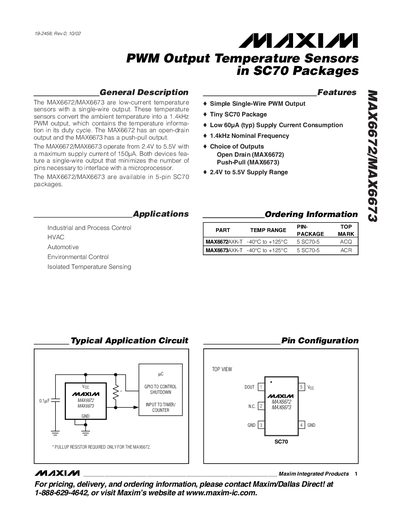
The MAX6672/MAX6673 are compact temperature‑sensor ICs in a 5‑pin SC70 package. They convert ambient temperature into a single‑wire PWM output whose duty cycle encodes the temperature. The MAX6672 provides an open‑drain output, while the MAX6673 offers a push‑pull output, both operating from 2.4 V to 5.5 V with a maximum supply current of 150 µA.
Typical applications include industrial and process control, HVAC, automotive environmental control, and isolated temperature sensing. The devices are designed for easy interfacing with microcontrollers or microprocessors using a single digital pin and a pull‑up resistor (required only for the MAX6672).
| Supply Voltage Range | 2.4 V to 5.5 V |
|---|---|
| Maximum Supply Current | 150 µA |
| Operating Temperature Range | -40 °C to +125 °C |
| PWM Nominal Frequency | 1.4 kHz |
| MAX6672 Output Type | Open‑drain |
| MAX6673 Output Type | Push‑pull |
They operate from 2.4 V to 5.5 V.
The PWM output has a nominal frequency of 1.4 kHz at +25 °C.
The MAX6672 provides an open‑drain digital output.
The MAX6673 provides a push‑pull digital output.