
LMP7707/LMP7708/LMP7709 is a precision, CMOS input, RRIO, wide supply range decompensated amplifier.
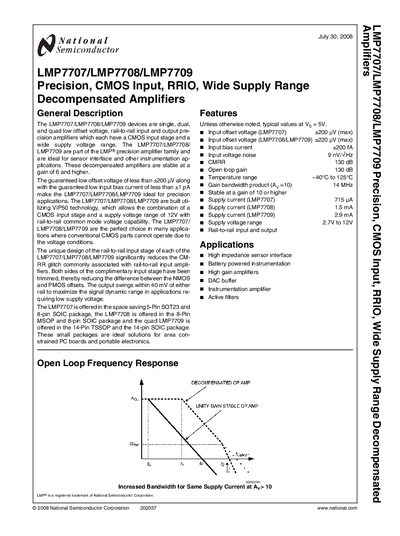
The LMP7707, LMP7708, and LMP7709 are precision, de‑compensated CMOS input amplifiers with rail‑to‑rail input and output capability. They feature ultra‑low offset voltage, low input bias current, and a wide supply voltage range, making them suitable for sensor interfaces and other instrumentation applications.
The devices are offered in compact packages (5‑pin SOT‑23, 8‑pin SOIC/MSOP, 14‑pin TSSOP/SOIC) and include detailed electrical characteristics, absolute maximum ratings, connection diagrams, and ordering information for designers.
| Input Bias Current | 200 fA |
|---|---|
| Supply Voltage Range | 2.7 V to 12 V |
| Gain Bandwidth Product (Ay = 10) | 14 MHz |
| Supply Current (LMP7707) | 715 pA |
| Supply Current (LMP7708) | 1.5 mA |
| Supply Current (LMP7709) | 2.9 mA |
The LMP7707 operates from 2.7 V up to 12 V.
The typical input bias current is 200 fA.
The LMP7708 is offered in 8‑Pin MSOP and 8‑Pin SOIC packages.
The gain‑bandwidth product at a gain of 10 is 14 MHz.