
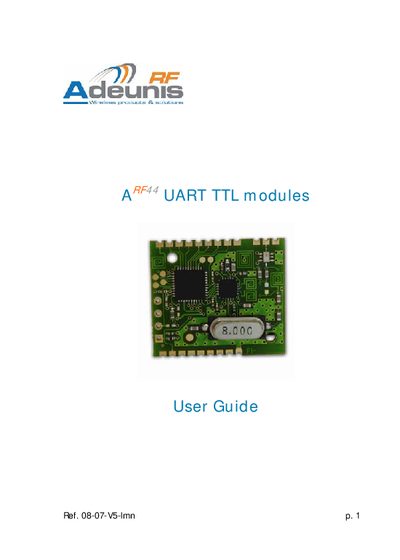
This guide describes the ARF44 radio transceiver, which converts serial data to a half‑duplex radio frame in the 863‑870 MHz band. It details the module’s interface, mechanical dimensions, signal pins, and the AT command set used to configure operating parameters such as channel selection and power modes.
The document also covers antenna requirements, noting that the module has no printed antenna and must be fitted with an external 4‑wave (8.6 cm) antenna or a 50 Ω coaxial connection. Technical specifications such as output power, sensitivity, operating voltage, current consumption, temperature range, and dimensions are listed, along with firmware version history.
| Frequency range | 863‑870 MHz |
|---|---|
| Number of channels | 14 |
| Sensitivity | -103 dBm (for 10°/PN9) |
| Operating voltage | 2.5 V – 3.6 V (3.3 V nominal) |
| TX current consumption | 36 mA (under 3.3 V) |
| RX current consumption | 23 mA (under 3.3 V) |
| Power‑down current | < 3 µA (typical) |
| Operating temperature | -20 °C – +70 °C |
| Dimensions | 23.2 mm × 26.65 mm |
| UART data rate | 19 500 bps |
The ARF44 module supports 14 selectable channels in the 863‑870 MHz band.
An external antenna is required; a 4‑wave (8.6 cm) antenna with a 50 Ω feed line is the recommended solution.
The module operates from 2.5 V to 3.6 V, with a nominal regulated voltage of 3.3 V.
The typical power‑down current is less than 3 µA.