
1-W MONO AUDIO POWER AMPLIFIER
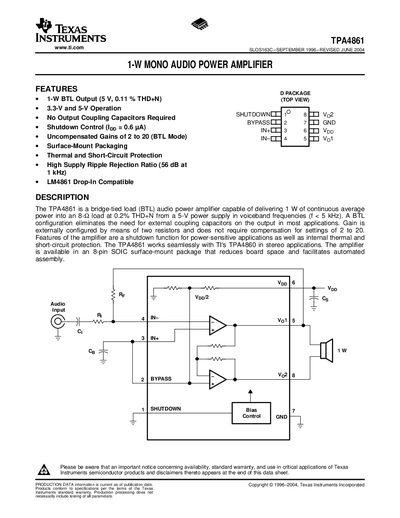
The TPA4861 is a bridge‑tied load (BTL) audio power amplifier that delivers up to 1 W continuous average power into an 8‑Ω load at 0.2 % THD+N from a 5‑V supply. It operates from 2.7 V to 5.5 V, supports gains of 2 to 20 in BTL mode, and requires no external output coupling capacitors.
Key features include shutdown control (0.6 µA), thermal and short‑circuit protection, high supply ripple rejection (56 dB at 1 kHz), and an 8‑pin SOIC surface‑mount package. The device is compatible with the TPA4860 for stereo applications and is offered in tape‑and‑reel form (TPA4861DR).
| Supply voltage range | 2.7 V to 5.5 V |
|---|---|
| Maximum output power (5 V supply) | 1 W into 8 Ω load |
| THD+N | 0.2 % at 1 kHz |
| Typical supply current (5 V) | 3.5 mA |
| Shutdown current | 0.6 µA |
| Gain range (BTL mode) | 2 to 20 |
| Supply ripple rejection ratio | 56 dB at 1 kHz |
| Package type | 8‑pin SOIC |
It can deliver up to 1 W into an 8‑Ω load.
The shutdown current is approximately 0.6 µA.
It operates from 2.7 V up to 5.5 V.
No, the amplifier does not require output coupling capacitors.