
The AD9352 is a fully integrated RF transceiver with integrated ADCs and DACs, designed for WiMAX/WiBro applications. It offers superior receiver sensitivity and highly linear transmitter characteristics, with features such as automatic gain control and transmit power control.
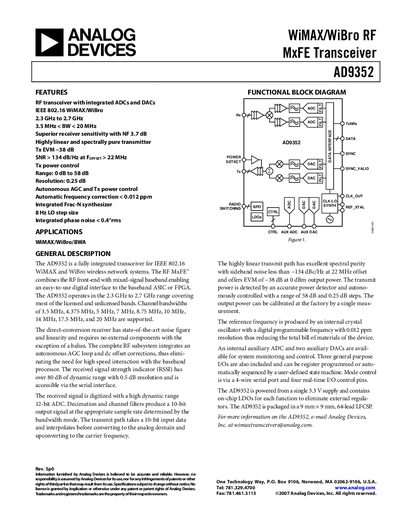
The AD9352 RF MxFE transceiver combines the RF front‑end with mixed‑signal baseband, providing a digital interface to ASICs or FPGAs for IEEE 802.16 WiMAX and WiBro networks. It operates from 2.3 GHz to 2.7 GHz and supports channel bandwidths from 3.5 MHz up to 20 MHz.
Key features include a 12‑bit integrated ADC, 10‑bit DAC, autonomous AGC, programmable Tx power control (0 dB‑58 dB range, 0.25 dB steps), an internal 8 Hz fractional‑N synthesizer, and low phase‑noise performance. The device is powered from a single 3.3 V supply and packaged in a 9 mm × 9 mm, 64‑lead LFCSP.
| Frequency range | 2.3 GHz to 2.7 GHz |
|---|---|
| Receiver noise figure | 3.7 dB |
| Transmit EVM | −38 dB |
| ADC resolution | 12‑bit |
| DAC resolution | 10‑bit |
| Tx power control range | 0 dB to 58 dB |
| Tx power control step size | 0.25 dB |
| LO step size | 8 Hz |
| Phase noise | < 0.4° rms |
| Supply voltage | 3.3 V |
| Package | 9 mm × 9 mm, 64‑lead LFCSP |
It operates from 2.3 GHz to 2.7 GHz.
The receiver has a noise figure of 3.7 dB.
The AD9352 includes a 12‑bit ADC.
It requires a single 3.3 V supply.